
Encouraging Movement & Playtime During Winter
When the January chill sets in, all any of us really want to do is curl up on the couch with a cozy blanket and a favorite movie. We all need those slow, restful days to recharge, but we also know that too much cabin fever can make little ones feel a bit wiggly and restless. We’ve put together some of our favorite ways to keep the energy up and the fun going, even when you’re stuck inside. Think of this season as a great excuse to get creative and find new ways to play, move, and explore together until the warmer days return.
 Why Moving Matters Most
For babies and toddlers, movement is their favorite way to say “hello” to the world. Every time they roll, crawl, or climb, they aren’t just playing—they are working hard on their strength and coordination. It’s also a big boost for their growing brains, helping them learn how to focus and figure out how things work.
At Keystone Daycare Center, we love seeing that “light bulb moment” when a child masters a new skill. We make sure our days are filled with plenty of space to wiggle and move in a safe, easygoing environment. We’ve found that when kids get to burn off some energy they actually find it much easier to settle down for naps and quiet story time later on. It’s all about finding that healthy balance that works for them.
Fun Ways to Keep Moving at Home
You don’t need a gym or a huge playroom to get your kids moving. Most of the time, the best equipment is already sitting in your living room!
- Family Dance Party- Music is a total game-changer on a gloomy afternoon. Put on some favorite tunes and let loose! You can take turns being the star of the show or learn some silly new moves together. It’s a wonderful way to share a laugh and get everyone’s heart rate up without even realizing you’re exercising.
- Build an Indoor Trail- If you have a crawler or a new walker, try making a “crawling trail” out of pillows and soft blankets. It’s like a mini-mountain range in your living room! For the older kids, you can turn this into a scavenger hunt with simple clues. Having them bear crawl to the next clue or hop like a bunny to the kitchen keeps things exciting and gets those muscles working.
- Interactive Reading Time- The next time you’re reading together, incorporate some real time interactions! If a character in the story jumps, everyone jumps. If there’s a gust of wind, everyone waves their arms. It’s a fun way to help them connect more with the story. Or collaborate to write your own family story, each member chooses a character name, story setting, etc.- imagine our own MadLibs turned into a play!
- The Ultimate Living Room Fort- Never underestimate the power of a good fort. Pull out all the pillows and couch cushions, some bed sheets, and a few clothespins or chip clips to hold it all together. The stretching and lifting it takes to build it—and the crawling it takes to hang out inside—is great for their physical development.
- Simple Home Workout Circuit- Creating home workouts as a family helps to model the importance of being active indoors and can be a routine everyone looks forward to. Set up a few stations around the room. You can use hula hoops to jump through, a laundry basket for a sock or ball toss, or just have a station for animal poses like stretching like a cat or balancing like a flamingo. It feels like a game, but it’s a great way to help them practice following directions and building motor skills. Here are a few more ideas to rotate into your new workout routine!
Getting Crafty Together
When it’s time to slow things down a little, crafts are a wonderful way to keep small hands busy. These activities are great for fine motor skills—the little movements that eventually help them learn to tie their shoes or hold a pencil.
- The Mitten Match- Cut out some mitten shapes from different colored paper. Mix them all up in a big pile and let your child find the matches. Once they’ve found the pairs, they can decorate them with markers or crayons. It’s a simple way to practice colors, shapes and patterns.
- Cotton Ball Snow Trees- Using some blue paper and a simple tree trunk cutout, let your child dab “snow” onto the branches using cotton balls or sponges dipped in white paint. It’s a fun, tactile way for them to see how their movements create different patterns on the page.
- Sticker Name Art- Write your child’s name in big, light letters on a piece of paper. Give them a sheet of stickers or some dot markers and let them trace the letters. It’s a great way for them to get familiar with the shapes of their name while strengthening their fine motor muscles.
Embracing the Great Outdoors
Even when it’s chilly, a little bit of fresh air can do wonders for everyone’s mood. As long as everyone is bundled up like little marshmallows, a quick trip outside can be the highlight of the day.
- Sledding and Tubing: Even a tiny hill is a big adventure for a toddler.
- Nature Walks: Bundle up in the stroller or take a walk to look for pinecones and other natural treasures. If you have a pair of toy binoculars, bring them along to look for any animals out and about.
- Snow Science: Make your own bubble solution for indoor experimenting! Try blowing bubbles in the cold air outside too—sometimes they’ll freeze right on the wand or in a pile of snow. Bring out your magnifying glass to look at the bubbles up close and for “clues” in the snow, like boot prints or little animal tracks.
- Snowman Families: If there’s not enough snow for a big snowman, try making a bunch of mini snowman for the window sill.
Join the Keystone Family
At Keystone Daycare Center, we truly value the partnership we have with our families. No matter the weather, we’re here to support you in keeping your little ones happy, healthy, and active. We’d love to welcome you into our community and show you how we make every day—even the snowy ones—a fun adventure for the children in our care. Contact us and we would be happy to answer any questions you may have. If you’re looking for a place where your child can grow and thrive, we’d love to meet you. Schedule a tour today!
Welcoming the New Year with Healthy Habits and Routines
As we welcome a new year, many families find themselves thinking about fresh starts, meaningful goals, and little ways to make every day smoother and more joyful. For families of all ages and stages, this is a perfect moment to focus on establishing strong, healthy habits and routines that support your children’s growth—and your peace of mind.
At Keystone Daycare Center, we know that routines aren’t just schedules on paper. They’re the rhythms that help children feel safe, supported, and ready to explore the world. Whether your child is new to our center or returning with a smile, routines bring consistency to experiences at home and in daycare so children thrive in both places.
Why Routines Matter
For infants and toddlers, routines are more than “to-dos.” Predictable patterns offer a sense of security and stability that’s essential in early development. When children know what comes next—whether it’s breakfast, nap time, or play—they feel comforted and capable, not uncertain or overwhelmed. This sense of predictability helps young children feel safe and builds trust with parents and caregivers. The foundation of a good routine brings emotional, cognitive, and social development that children carry with them as they grow.
Here’s what research and early childhood educators highlight about routines:
- Emotional regulation & security: A consistent routine offers comfort and predictability that helps children regulate feelings like frustration or anxiety.
- Behavior support: When children know what to expect, they behave better, transition more easily between activities, and experience fewer tantrums or power struggles.
- Learning opportunities in everyday moments: Daily routines provide teachable moments—like learning to wash hands before meals, putting toys away after play, or saying “hello” and “goodbye” to friends.
Habits You Can Build at Home
Creating routines doesn’t mean making your day rigid. Instead, it’s about consistent rhythms that make life easier and more predictable for everyone. Small steps like these make routines feel comforting, not chaotic, and give children opportunities to feel capable and valued. Here are practical, nurturing habits to incorporate:
- Sleep & Rest: Aim for consistent nap times and bedtimes. This helps support healthy sleep patterns and reduces evening struggles.
- Meals & Snacks: Eating together when possible—without devices—builds strong habits around food and communication.
- Play & Language Time: Reading books, singing songs, or talking through simple routines like getting dressed turn daily moments into meaningful interactions.
- Hygiene Habits: Brushing teeth, washing hands before meals, and putting away belongings after play reinforce responsibility and confidence.
How Daycare Supports Family Routines
At Keystone Daycare Center, we do more than supervise children—we reinforce routines that complement what families are building at home. Daycare doesn’t have to replace family routines—it strengthens them. By syncing day-to-day schedules with what families do at home, children experience continuity that supports both emotional security and joyful learning.
Here’s how structured daycare programs help:
- Predictable daily schedules with set times for learning, play, meals, and rest mirror routines at home and strengthen consistency.
- Social interactions help little ones develop communication, cooperation, and social awareness with peers.
- Guided learning activities encourage exploration and growth in ways that feel natural and fun.
- Professional care from trained educators ensures that each child’s developmental needs are met with warmth and experience.
Partnering With Families
At Keystone, we believe routines work best when families and caregivers are on the same team.
Here are ways we collaborate:
- Open communication: Sharing updates about nap times, mealtimes, and favorite activities helps everyone stay in rhythm.
- Sharing support: We love hearing what’s working at home and how we can support you through changes and transitions.
- Celebrating milestones: Each child grows at their own pace. Celebrating achievements—big or small—reinforces confidence and strengthens routines.
 A Fresh Start for the New Year
The new year is a wonderful time to reflect on what’s working and make small, meaningful changes. Routines don’t need to be perfect—just purposeful, consistent, and rooted in love. Together, we can help the little ones to feel secure, supported, and excited for every part of life.
From all of us at Keystone Daycare Center, we’re grateful to partner with your family as we build routines that support healthy habits, joyful learning, and lifelong curiosity.
Still searching for a new daycare for your family? Schedule a tour of our center. Our team is happy to answer any questions, just contact us today.
Let’s make this year one filled with warmth, laughter, growth, and structure that feels good for your whole family!
A Season of Care, Comfort, and Growing Together
December is a season of celebrating holidays with loved ones, enjoying cozy moments, and reflecting on the year. For families with babies and toddlers, it’s also a time to take notice of just how much your little ones are growing and changing. During these early years, having a trusted childcare environment can make a meaningful difference for both children and parents.
At Keystone Childcare Center, we aim to support families by providing consistent, nurturing care that feels like a natural extension of home.
 Supporting Little Ones from the Start
Babies and toddlers thrive when they feel safe, comfortable, and cared for. Daily routines, familiar faces, and patient guidance help children build trust and confidence—especially during the busy winter season.
At Keystone, our caregivers focus on:
-
-
- Responding to each child’s individual needs
-
- Maintaining calm, predictable routines
- Encouraging exploration through age-appropriate play
These early experiences help lay the groundwork for emotional security and early learning.
Learning About Others, One Small Moment at a Time
The month of December often highlights how important connection truly is. In daycare, babies and toddlers begin learning about the world beyond their families in supported ways.
Through play, music, and shared activities, children have opportunities to:
- Practice early social skills
- Become comfortable around peers
- Build confidence in group settings
Our classrooms are thoughtfully designed to support these interactions at a pace that feels right for each child.
Supporting Families During a Busy Season
The holidays can bring full schedules and added responsibilities. Having reliable childcare helps families maintain routines and balance during this time of year.
Keystone Childcare Center works closely with parents by:
- Offering dependable, year-round care
- Communicating regularly about each child’s day
- Creating a welcoming environment for both children and families
We understand how important trust and consistency are when it comes to your child’s care.
Cozy Winter Days and Simple Seasonal Joy
December at Keystone is centered on warmth and comfort. Our classrooms include seasonal touches like winter-themed stories, music, and sensory activities that are calm and developmentally appropriate for babies and toddlers.
These simple experiences allow children to enjoy the season while feeling secure and supported.
Looking Ahead to the New Year
As the year comes to a close, many families take time to reflect on the care and support that help their children thrive. Choosing the right daycare is an important decision, and we’re honored when families consider Keystone Childcare Center as part of their child’s early journey.
Interested in learning more?
We invite families to schedule a tour, reach out with questions, or explore enrollment options for the new year. Seeing our classrooms and meeting our caregivers can help you decide if Keystone Childcare is the right fit for your child and your family.
From our Keystone family to yours, we wish you a warm holiday season and a joyful start to the new year!
Handmade Holiday Gifts by Toddlers | Keystone Childcare
The holiday season is officially here, and what better way to celebrate than by creating meaningful, handmade gifts with your little ones! Gifts made by your toddlers and babies—with some parental guidance—can be the most treasured mementos. They capture a moment in time and showcase your child’s unique developmental stage.
Here are a few simple, safe, and adorable craft gift ideas that are perfect for a family with toddlers and babies to make for loved ones!
For the Baby (Ages 6–18 Months)
These crafts are all about capturing their tiny features and generally make a small mess for a quick clean up.
Salt Dough Hand print Ornaments
This is a classic for a reason! It’s a beautiful way to capture the exact size of your baby’s hand or foot. Tip: Do this while they are calm or even sleeping!
Materials Needed
- 1 cup flour
- ½ cup salt
- Rolling pin
- Straw (to make a hole)
- Ribbon or twine
- Acrylic paint or washable paint
- Clear sealer or Mod Podge (optional)
Instructions
- Make the dough: Mix flour, salt, and warm water until a dough forms.
- Roll out: Roll dough to about ½ inch thick.
- Create shape: Cut out a circle with a bowl or large cookie cutter.
- Add hand print: Gently press your toddler’s hand into the dough to leave a deep print.
- Add hanging hole: Use a straw to poke a hole near the top.
- Bake: Place on a baking sheet and bake at 250°F (120°C) for 2–3 hours until hard.
- Paint: Once cool, let your toddler paint the ornament.
- Seal & hang: Seal with Mod Podge if desired and add ribbon.
- Add the child’s name and the year on the back.
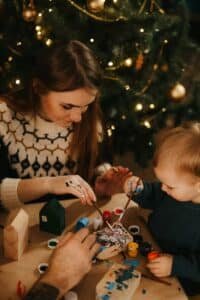 Finger-Painted Photo Frame Gift
Perfect for gifting to family and totally toddler-made.
Materials Needed
- Wooden or cardboard photo frame (from a dollar store or craft store)
- Washable paints
- Large paintbrush or sponge
- Photo of your child
- Baby wipes / damp cloth
Instructions
- Prepare frame: Remove the photo insert and set the blank frame on a covered surface.
- Paint: Let your toddler decorate the frame with finger paint or dab it with paint and a sponge.
- Dry: Allow it to dry completely.
- Insert photo: Place a favorite picture of your toddler inside.
Canvas Footprint Art
A simple canvas can be transformed into a beautiful piece of modern art!
Materials: Small canvas, non-toxic, washable acrylic paint (use complementary colors like red/green or blue/silver), paint brush.
- Paint a thin, even layer of one color onto the baby’s foot.
- Press the foot firmly but gently onto the canvas.
- Clean the foot immediately!
- Let the print dry completely.
- Idea: Turn the footprint into a reindeer (add antlers and a red nose!) or a snowman (use white paint).
For the Toddler (Ages 18 Months–3+ Years)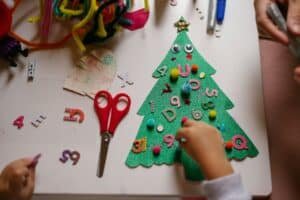
Hand print Christmas Tree Card
Materials Needed
- Green washable paint- Use non-toxic, washable paints
- Brown washable paint or a brown marker
- Yellow paper or sticker for the star
- Small colorful dot stickers (optional for ornaments)
- White card stock or folded construction paper
- Paintbrush
- Baby wipes / damp cloth
Instructions
- Prepare the card: Fold the card stock to make a card.
- Paint the hand: Brush green paint onto your toddler’s hand.
- Stamp the tree: Press the hand print onto the front of the card with fingers pointing downward (the hand print will form the tree branches).
- Repeat 2–3 overlapping prints to make a fuller “tree.”
- Repeat 2–3 overlapping prints to make a fuller “tree.”
- Add the trunk: Draw or paint a small brown rectangle at the base.
- Decorate: Let your toddler add dot stickers as ornaments and place a star sticker at the top.
- Dry: Allow to dry completely.
Cotton Ball Snowman
Materials Needed
- Cotton balls
- Paper plate or white construction paper
- Glue stick or non-toxic school glue
- Googly eyes or paper cutouts
- Orange paper triangle for the nose
- Scrap paper shapes for buttons, scarf, and hat
Instructions
- Prepare the base: Draw or cut out a simple snowman shape on paper OR use the paper plate as the snowman’s body.
- Add glue: Help your toddler smear glue onto the snowman area.
- Stick cotton balls: Let them press cotton balls all over the glued area.
- Decorate:
- Add eyes, nose, scarf, hat, and buttons
- Add eyes, nose, scarf, hat, and buttons
- Dry: Let the project dry before displaying.
Toddler-Safe Holiday Sensory Ornaments (Shatterproof!)
Materials Needed
- Clear plastic fill-able ornaments
- Large ribbon pieces or wide strips of tissue paper
- Large jingle bells (optional, only if safe for your child)
- Pom-poms (large size)
- Stickers (optional)
Instructions
- Open the ornament: Remove the top of the plastic ornament.
- Offer materials: Let your toddler stuff in pom-poms, tissue paper, ribbon pieces, or other soft items.
- Add sound (optional): Add one large jingle bell
- Close the ornament: Secure the top tightly (you can glue it shut for extra safety).
- Decorate the outside: Let them add stickers to the outside.
Painted Holiday Tea Towels or Tote Bags
Materials Needed
- Plain cotton tea towel OR canvas tote bag
- Non-toxic fabric paint
- Paper plate for paint
- Sponge shapes (stars, trees, hearts, circles) or your toddler’s hand
- Cardboard to place inside the fabric to prevent paint bleeding through
Instructions
- Prep fabric: Lay the towel or bag flat and slide cardboard inside.
- Stamp shapes: Dip sponge shapes in fabric paint and help your toddler stamp them onto the fabric.
- Hand print option: Paint your toddler’s hand and press it onto the fabric for a keepsake.
- Hand print option: Paint your toddler’s hand and press it onto the fabric for a keepsake.
- Add details: You can add “2025” or the child’s name with a fabric marker (optional).
- Dry: Let dry according to paint instructions (usually 24 hours).
- Tie with a ribbon and pair with a small baked treat or candle.
Remember, the goal isn’t perfection—it’s connection!
- More than making gifts, this crafting time together is building your child’s fine motor skills and self-esteem.
- Keep it Short: Toddlers and babies have short attention spans. If the craft takes more than 10–15 minutes, break it up over two sessions.
- Embrace the Mess: Cover your work surface completely and dress your little one in clothes you don’t mind getting messy.
We can’t wait to hear about the wonderful creations your little artists make this season. Are you still looking for your child’s new daycare center? Schedule a tour to learn more about Keystone Childcare today. Happy crafting and Happy Holidays!
From Coos to Conversations: Nurturing Your Tiny Talker
At Keystone Childcare Center, we love listening to the happy sounds—from coos and babbles to those exciting first words—that fill our classrooms every day. Language development is a marathon, not a sprint, and these early years are crucial for building the skills your child will use for a lifetime of communication.
This week, let’s explore simple, powerful ways you can foster language growth in your babies and toddlers, turning everyday moments into learning opportunities.
For Our Littlest Learners (0-18 Months): The Power of Serve and Return
For babies, language learning starts with listening and connection. The concept of Serve and Return is foundational: your baby “serves” a cue (a sound, a gaze, a movement), and you “return” it with attention and a response.
- Narrate Everything: Talk about what you’re doing, even if it feels silly. “Mommy is putting on your red sock now.” “Look, the doggy is walking outside!” This connects words to objects and actions.
- Respond to Babbling: If your baby says “ba-ba,” respond with “Yes! That’s a ball!” or “Are you saying bottle?” This validates their attempts and models clearer sounds.
- Ask and Wait: When you show a baby a toy, ask a simple question like, “Do you want the bear?” and pause. This gives them time to process the language and respond, even if the response is just a kick or a reach.
- Sing and Read: Simple nursery rhymes and board books introduce rhythm, rhyme, and a wide variety of sounds.
 For Our Emerging Talkers (18 Months+): Expanding Their World
As toddlers start putting words together, you can help them expand their vocabulary and sentence structure through these techniques:
- Expansion: When your toddler says a short phrase, you simply repeat and expand on it.
- The toddler says: “Dog run.”
- You say: “Yes, the doggy is running fast!”
- Self-Talk and Parallel Talk: Describe what you are doing and what they are doing. This connects language directly to their immediate experience.
- Self-Talk: “I am chopping the bananas for a snack.”
- Parallel Talk: “You are stacking the blue block on top of the yellow block!”
- Use Descriptive Words: Instead of just saying “big,” use words like huge, enormous, gigantic, or switch “happy” for joyful, cheerful, excited. This helps them build a nuanced vocabulary.
- Follow Their Lead: If your child is fascinated by a particular object (e.g., a truck), engage with them fully on that topic, using rich vocabulary related to it (tires, engine, dumping).
- Reminder: Don’t worry about perfect grammar right now! Focus on keeping the conversation fun, positive, and flowing. The goal is communication, not correction.
Bridging the Gap: Simple Baby Sign Language
Before your little one can articulate words, their hands are ready to communicate! Introducing simple Baby Sign Language can dramatically reduce frustration for both children and parents by giving toddlers and older babies a way to express basic needs.
- Start Simple: Focus on high-value words that they need frequently, like Mom, Dad, More, All Done, Eat, Milk, and Please.
- Sign and Say: Always say the word out loud while you are making the sign. This reinforces the spoken language alongside the movement. The sign is a temporary bridge, not a replacement for speech.
- Be Consistent: Use the sign every time you use the word (e.g., every time you offer milk, make the sign for Milk). Check out this video to start with the Basics!
 Screens and Speech: A Careful Balance
The American Academy of Pediatrics (AAP) currently recommends avoiding screen time (other than video chatting) for children younger than 18 months and limiting it to high-quality programming for one hour a day for children aged 2 to 5.
When considering screen time, remember that language is best learned through back-and-forth, real-time interaction.
- Prioritize Interaction: Passive screen viewing doesn’t allow for the critical “serve and return” loop. The brain learns language much better from an engaging person than from a 2D image.
- Co-View and Talk: If you choose to use screens for older toddlers, sit with them and talk about what you are watching. Pause the video and ask, “What color is the apple?” or “Where did the dog go?”
- Use it as a Tool, Not a Crutch: Screens are best used sparingly and intentionally, never as a primary source of language exposure.
We are here to support your child’s language journey every step of the way. We believe that language development thrives in a strong community, and we look forward to partnering with you to celebrate every milestone—big and small. Schedule a tour of our center today and consider joining the Keystone family!
Raising Givers: Cultivate Gratitude through Activities & Volunteering
As the leaves change and the air turns crisp, November and Thanksgiving reminds us to pause and reflect on all the wonderful things in our lives. At Keystone Childcare Center, we understand teaching gratitude to babies and toddlers happens through modeling appreciation, creating joyful moments, and recognizing the good things that happen every day. This month, we encourage our families to celebrate thankfulness with these simple, heartfelt activities and family-friendly volunteering ideas.
Simple At-Home Gratitude Activities
Even before they can talk, babies and toddlers are learning by example. These activities are designed to be hands-on and centered around growing your family bonds.
- The Thankful Basket: Gather a small basket and fill it with simple things your child enjoys: a favorite soft toy, a cozy blanket, books or brightly colored blocks. As you show each item, name it and say, “We are so thankful for our soft bunny because it gives great cuddles!”
- Picture Book Gratitude: Create a simple photo album of friends and family. As you look at the book together, point and say, “We’re thankful for Daddy because he plays peek-a-boo!”
- The Gratitude Walk: Take a short walk around your neighborhood or a local park. Encourage your toddler to point out things they notice. You can name the things you are thankful for: “I’m thankful for the pretty red leaves!” or “I’m thankful for the sunshine that keeps us warm!”
- “Thank You” Songs and Rhymes: Make up a simple, silly song about gratitude. Use a familiar tune and replace the words with expressions of thanks. Example: (To the tune of “Twinkle Twinkle Little Star”) “Thank you, thank you, for our shoes, thank you for the food we choose!” Talking through and describing the details of your times together builds their vocabulary and deepens your bonds.
- Bedtime Reflection: End the day with a Gratitude Cuddle. As you hold your little one, quietly share one or two simple things you were grateful for from that day—their infectious giggle, a yummy meal, or a hug. This models the habit of reflection and fosters security in sharing together.
- Home-made Thank You Cards: Gather crayons and paper. Help your toddler make simple, colorful drawings. You can add a note that says, “Thank you for all you do!” and deliver them to your mail carrier, sanitation worker, pastor, or anyone who helped your family recently.
- The Clean-Up Crew: Model thankfulness for your home by tidying up toys that are no longer played with. Involve your toddler in putting toys into a “giving box” and explain, “We have so many toys! Let’s share some with friends who don’t have as many.” Drop off items together as a family at a local shelter or non-profit.
 Giving Back Can Be Toddler-Friendly!
Volunteering helps children understand that thankfulness leads to action—sharing our blessings with others. With little ones, look for volunteering opportunities that are well structured and have a shorter time commitment- not too close to nap time- to be more enjoyable for all involved.
- Host a Diaper Drive: The National Diaper Bank Network has resources to sign up to host and collect diapers for families in need in your community. Have your toddler decorate a large box and fill it with new diaper packs.
- Canned Food Collection: While older children can sort, even a toddler can place non-perishable food items into a donation box at home. Make it a fun game to put the cans in the box, and take them with you to drop off at a local church or community pantry.
- Pack a shoebox for underserved children through Operation Christmas Child: Gather a few small toys, school supplies, practical necessities and include a letter from your family to bless a child or 2 in need.
- Local Animal Shelters: Contact your local humane society. They often accept donations of old towels, blankets, or pet food, which you and your child can drop off during their operating hours. Or check to see if they are looking for volunteers to foster animals temporarily.
- Children’s Hospital: Contact your local Children’s Hospital as they often have wish lists for toys, books, and craft supplies for their patients. Shopping for new items to donate together is a wonderful way to teach compassion.
Teaching gratitude is a continuous journey! By weaving these simple, heartfelt moments into your daily routine, you are helping your little one grow a thankful heart.
This Thanksgiving, we are most thankful for YOU! Schedule a tour at Keystone Childcare Center today. We look forward to hearing your favorite ideas and traditions to practice thankfulness at home this season.